
Story audio is generated using AI
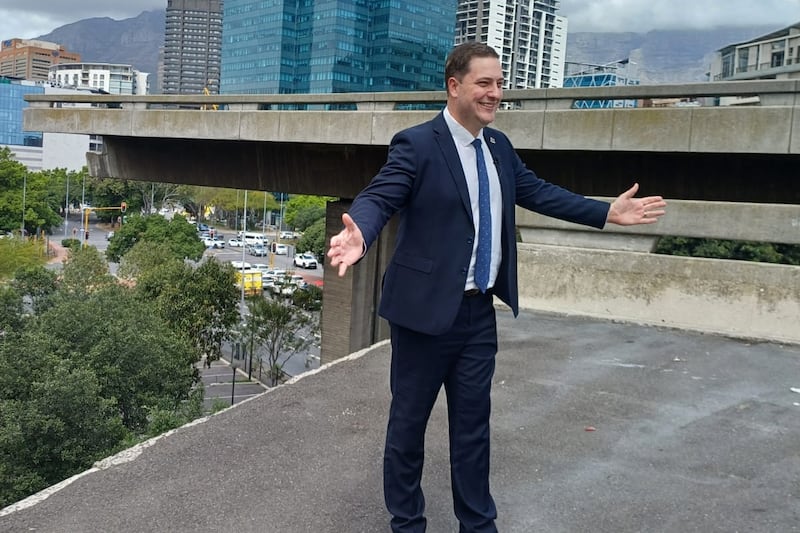
For more than half a century, Cape Town’s unfinished highways have hung above the Foreshore, concrete reminders of an ambitious transport project abandoned before it could connect the city.
Now, more than 50 years after construction began, the City of Cape Town wants to finish the job, but with a far broader vision than simply completing two bridges.
Mayor Geordin Hill-Lewis on Friday unveiled plans to transform the Foreshore’s unfinished highways into a new bridge-and-tunnel system aimed at easing congestion, while opening up land for a new inner-city neighbourhood with affordable housing, public spaces and a tree-lined promenade stretching towards Sea Point.
The unfinished highways were conceived in the late 1960s, with construction beginning in the early 1970s as part of plans to connect the Eastern and Western Boulevards and ease traffic congestion into the Cape Town CBD. Construction stopped in 1977, largely because of financial constraints, leaving sections of elevated freeway abruptly suspended above the Foreshore.
Over the decades, the unfinished structures have become among Cape Town’s most recognisable man-made landmarks, featuring in films, photographs and urban legends.
City manager Lungelo Mbandazayo said the project presented an opportunity to turn what had become a symbol of an unfinished chapter in Cape Town’s history into part of the city’s future.
“These structures have captivated imaginations, featured in films and stories, and more recently became the subject of their own urban legends,” he said.
Mbandazayo said the city began examining the precinct’s future about two years ago, with officials considering the challenges facing the area, Cape Town’s future infrastructure needs and how the development could ultimately benefit residents.
“Cities are not built for the buildings, roads or infrastructure. Cities are built for people, and so, as we develop a vision for the Foreshore precinct, our residents have remained at the centre of every conversation, every proposal and every possibility,” he said.
He described the proposal as some of the boldest thinking the city had put forward for the CBD in recent years.

“What was once a symbol of an unfinished chapter in our city’s story could now become the starting point for a new one,” Mbandazayo said.
Hill-Lewis said completing the unfinished highways would go beyond solving a decades-old infrastructure puzzle, with the city hoping the development will unlock investment, jobs and affordable housing in the heart of Cape Town.
“We’ve been working on this project for the last few years in detail, but in truth, we’re getting the ball rolling on finishing some 50-year-old unfinished business,” he said.
“These are not just bridges. They will help address some of Cape Town’s biggest congestion headaches, while unlocking huge investment, job creation and more affordable homes for Capetonians.”
Under the proposal, the unfinished highways would be transformed into a new link bridge and tunnel aimed at improving the connection between the Foreshore and the Atlantic Seaboard.
The longer-term plan would also unlock land for a new Foreshore neighbourhood, incorporating affordable housing, pedestrian-friendly streets, public spaces and a tree-lined promenade along the harbour edge towards Sea Point.
Hill-Lewis said the development was also intended to reconnect the CBD with the coastline.
“Cape Town is one of the world’s great port cities, and everything about our identity is shaped by the sea. By removing the physical barriers between city and sea, we will reconnect with our maritime identity and heritage,” he said.
The proposal is still at an early stage and construction is not imminent. The city will first take the plans through public consultation before final designs are developed into detailed engineering plans, followed by procurement and, ultimately, construction.
Hill-Lewis said Friday’s announcement marked the beginning of the public phase of the project.
“There is still a lot of work to do and a long way to go. Today is the beginning of the public-facing phase. We are releasing drawings to begin a process of public consultation,” he said.
To minimise disruption to traffic, the city proposes carrying out construction in two phases while keeping existing freeways operational.
During the first phase, a new bridge would be built over Buitengracht Road and the incoming elevated freeway widened to link inbound traffic directly to Helen Suzman Boulevard. The plans also include a large public park and public spaces beneath the infrastructure.
The city believes the link would allow motorists travelling from the Foreshore towards Green Point, Sea Point and other parts of the Atlantic Seaboard to bypass sections of the CBD, easing congestion in the city centre.
In the second phase, an outbound tunnel will be constructed and the existing outbound elevated freeway demolished.
Removing that section of freeway will open up land for the proposed promenade and new Foreshore neighbourhood, potentially turning one of Cape Town’s most famous unfinished projects into the centrepiece of a major redevelopment of the inner city.
TimesLIVE





Would you like to comment on this article?
Sign up (it's quick and free) or sign in now.
Please read our Comment Policy before commenting.