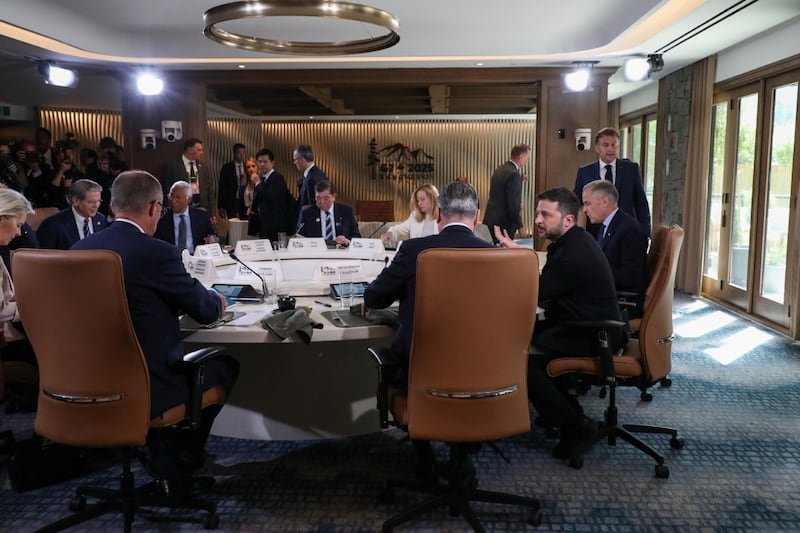
Ukrainian President Volodymyr Zelensky will leave the Group of Seven summit on Tuesday with new aid from host Canada for its war against invader Russia but without a joint statement of support from members or a chance to meet US President Donald Trump.
The G7 wealthy nations struggled to find unity over the conflict in Ukraine after Trump expressed support for Russian President Vladimir Putin and left a day early to address the Israel-Iran conflict from Washington.
Canada dropped plans for the G7 to issue a strong statement on the war in Ukraine after resistance from the US, a Canadian official told reporters. Canadian Prime Minister Mark Carney said Ottawa would provide C$2bn (R26.3bn) in new military assistance for Kyiv and impose new financial sanctions. A Russian attack overnight on Kyiv and other cities that killed at least 18 people “underscores the importance of standing in total solidarity with Ukraine”, Carney said.
He said when G7 leaders met for dinner in the Rocky Mountain resort area of Kananaskis on Monday before Trump left, they stressed the importance of using “maximum pressure against Russia” to force it to start serious peace talks.
Zelensky said he had told the G7 leaders “diplomacy is in a state of crisis” and said they need to continue calling on Trump “to use his real influence” to force an end to the war.
“Even if the American president is not putting enough pressure on Russia, the truth is America has the broadest global interests and the largest number of allies. All of them will need strong protection,” he said in a post on his Telegram account.
Though Canada is one of Ukraine's most vocal defenders, its ability to help Kyiv is far outweighed by the US, the largest arms supplier. Zelensky had said he hoped to talk to Trump about acquiring more weapons.
When the summit ended later on Tuesday, Carney planned to issue a chair statement calling for more pressure on Russia through sanctions and saying the G7 backs US-led peace efforts, two G7 sources said.
Canada holds the rotating G7 presidency this year. Other leaders do not need to sign off on G7 chair statements.
A European official said leaders had stressed to Trump their plans to be hard on Russia and Trump seemed impressed, though he does not like sanctions in principle.
Three European diplomats said they had heard signals from Trump that he wanted to raise pressure on Putin and consider a US Senate bill drafted by senator Lindsey Graham, but that he had not committed to anything.
“I am returning to Germany with cautious optimism that decisions will also be made in America in the coming days to impose further sanctions against Russia,” said German Chancellor Friedrich Merz.
G7 leaders agreed on six statements about migrant smuggling, artificial intelligence, critical minerals, wildfires, transnational repression and quantum computing.
Trump said on Monday he needed to be back in Washington as soon as possible due to the situation in the Middle East, where escalating attacks between Iran and Israel have raised risks of a broader regional conflict.
He later said his early departure from the summit had “nothing to do with” working on a ceasefire between Israel and Iran, however, denying comments by French President Emmanuel Macron, who had said the US president leaving could be a sign of a potential deal.
A White House official on Tuesday said Trump explained he returned to the US because it is better to hold high-level national security council meetings in person rather than over the phone.
Trump did agree to a group statement published on Monday calling for a resolution of the Israel-Iran conflict.
The statement said Iran is the principal source of regional instability and terror and Israel has the right to defend itself.
On arriving at the summit on Monday, Trump said the then-Group of Eight had been wrong to expel Russia after Putin ordered the occupation of Crimea in 2014.
The Kremlin said on Tuesday Trump was right and said the G7 was no longer significant for Russia and looked “rather useless”.
Many leaders had hoped to negotiate trade deals with Trump, but the only deal signed was the finalisation of the US-UK deal announced last month. Treasury secretary Scott Bessent remained at the summit after Trump left.
Carney also invited non-G7 members Mexico, India, Australia, SA, South Korea and Brazil as he tries to shore up alliances elsewhere and diversify Canada's exports away from the US.
Carney warmly welcomed Indian counterpart Narendra Modi on Tuesday after two years of tense relations between Canada and India.
Reuters



Would you like to comment on this article?
Sign up (it's quick and free) or sign in now.
Please read our Comment Policy before commenting.