
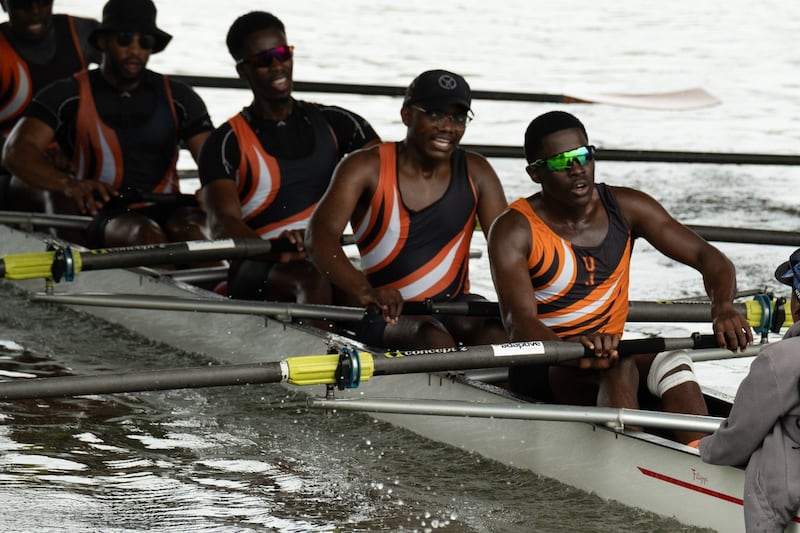
When Michael Edwards looked at the RMB Universities Boat Race on the Kowie River in Port Alfred, he saw more than crews battling over 6km of water.
He saw a sport that has become increasingly accessible, a growing pool of young talent and athletes pushing themselves beyond limits they may not have known existed.
That is one of the most important legacies of RMB’s 10-year partnership with Rowing South Africa, he said.
The Universities Boat Race 2026 took place from September 10 to 12.
The financial services group has backed rowing across the development spectrum, from schools and universities to the national squad, helping to create platforms where athletes can compete, develop and aspire to represent their country on the international stage.
For Edwards, one of the clearest signs that the investment is making a difference is the changing composition of the Universities Boat Race.
“Every year we see the depth of the crews as well as the diversity of the crews increasing year-on-year,” he said.
“The smaller, traditionally smaller, clubs that five years ago couldn’t afford to come or couldn’t or weren’t here are now here with two men’s crews and two women’s crews. And that’s incredible.”
Every year we see the depth of the crews as well as the diversity of the crews increasing year-on-year
— Michael Edwards
That development is significant in a sport that has traditionally been viewed as expensive and inaccessible.
“There’s no two ways about it; it’s a very expensive sport,” Edwards said.
“The boats are expensive, the travel’s expensive, the equipment’s expensive, coaches, athletes — you’ve got to account for all of that.”
RMB’s sponsorship has therefore been directed not only at the elite end of the sport but also at creating opportunities for more people to participate.
Over the past decade, the company has supported rowing at school level, university level and through the national squad.
The objective is to make sure talent does not disappear simply because an athlete cannot afford to pursue the sport.
“RMB sponsorships over the years have contributed to making it, whether it’s at the school level, university or the RMB national squad, making the sport more accessible for more people,” Edwards said.
The result could be seen at the Kowie, where athletes from universities around the country came together to compete.
For Edwards, the growth in participation is as important as who crosses the finish line first.
“There are unbelievable athletes here this weekend from around the country,” he said.
“But there are also people who are just trying out a new sport, and it’s pushing them to their own limits.”
Those limits do not necessarily have to result in an Olympic medal or a place on a national team.
But there are also people who are just trying out a new sport, and it’s pushing them to their own limits
— Michael Edwards
“Those limits are pushing them to success in whatever they choose to pursue in future endeavours, in their future careers,” Edwards said.
That is a particularly important part of the impact Edwards sees in university rowing: the sport develops people regardless of whether they ultimately become elite athletes.
More than 200 students were on the water at the Universities Boat Race, and for many the experience was about testing themselves against a demanding physical and mental challenge.
Edwards pointed to an incident during the event involving the Rhodes women’s crew.
After encountering a problem shortly before the finish, the crew continued rather than abandoning the race.
“Everybody was cheering,” he recalled.
For Edwards, those moments captured what the sponsorship is ultimately trying to support.
His message to athletes after the event was straightforward.
“Whether you’re going home with a medal around your neck or not, I hope you’re proud.
“I hope you’ve used this event to your advantage to build character, build new friends, and create a stronger bond between yourself and your peers, but also take the opportunity to engage with people that you wouldn’t have.”
The physical demands of the Kowie course make that lesson particularly powerful.
“I’ve never done it. Six kilometres down the Kowie is unbelievably tough,” Edwards said.
“You’ll never forget that as long as you live, you’ll lean on that as a point of departure for future grit and resilience that you need in life.”
It’s a beautiful aspect of this rowing community; it’s how intimate it is and how much they are willing to come back and give back
— Michael Edwards
The impact is also visible in the athletes and coaches who have come through the rowing system and subsequently returned to contribute to the sport.
Edwards describes rowing as a sport “defined by reciprocity”, with successful athletes frequently coming back to coach and support the next generation.
“99.9% of those rowers will come back and give back,” he said.
He pointed to people such as Sizwe Ndlovu and John Smith as examples of people who have come through the sport and subsequently contributed to its development.
“That makes us incredibly proud, and it’s something we want to contribute to,” Edwards added.
For RMB, seeing former athletes return to the sport reinforces the sense of community around rowing.
“It’s a beautiful aspect of this rowing community; it’s how intimate it is and how much they are willing to come back and give back,” Edwards said.
The achievements of the country’s Olympic and world championship medallists demonstrate to young athletes that international success is possible.
“And I think all those names you just mentioned, in the Olympic gold medallists, are so accessible. That’s inspiring; it’s aspirational for people to come onto the water and see, ‘Well, I’ve watched your journey, and I’m at the same point where you were.’”
One of the challenges has been breaking down the perception that rowing is a sport for a limited section of society.
Edwards acknowledged that in some communities the sport has historically been seen as expensive and inaccessible, while there can also be a barrier for people who are unfamiliar or uncomfortable with the water.
He said programmes such as indoor rowing and learn to row initiatives are helping to address that.
Before an aspiring rower even gets into a boat, indoor rowing can provide an accessible introduction to the sport and a way of identifying physical potential.
“You can teach technique; you can’t teach talent,” Edwards said.
Rowing South Africa, together with programmes such as those facilitated by Virginia Mabato, is helping to create that foundation.
The progression from indoor rowing and swimming to the water and ultimately university competition creates a pathway that previously may not have been available to many young people.
For Edwards, that is where the long-term significance of the sponsorship lies.
“Importantly, it’s the full breadth of the sport,” he said of RMB’s commitment.
“But you have to start at the grassroots to get that talent, maintain the talent, and stick it into the pipeline that ultimately gets to LA.”
The reference is to the 2028 Los Angeles Olympics, but Edwards is careful not to reduce success to medal counts.
The RMB national squad has consistently made the company proud by competing against much larger international budgets, he said.
“Regardless of whether we are winning medals, the RMB national squad has made us so proud of the 10-year partnership history that we’ve had.
“Yes, we are always dreaming of medals,” he added, but the journey matters too.
That philosophy is reflected in what Edwards believes constitutes a successful Universities Boat Race.
For the athletes, it is about leaving with greater confidence, stronger relationships and a deeper understanding of what they can achieve.
For the sport, it is about growing participation and creating a sustainable pipeline.
And for RMB, it is about using its resources to ensure that talent has somewhere to go.
The exciting part for Edwards was watching the finals.
“Likely, there is an Olympic rower on the water this weekend [September 10 to 12], and we may unearth them in 2028, maybe 2032,” he said.
That possibility is perhaps the most tangible expression of what a decade of sponsorship can achieve.
Not simply supporting the champions who have already emerged, but helping create the conditions in which the next ones can emerge.
TimesLIVE









Would you like to comment on this article?
Sign up (it's quick and free) or sign in now.
Please read our Comment Policy before commenting.