

SA has again become the backbone of paleontological discoveries, this time with the help of Tucky, a 200-million-year-old dinosaur, and a giant specialised X-ray machine in France.
For years palaeontologists have known how certain species of dinosaurs, such as theropods like the T-Rex and the long-necked sauropods like the Brontosaurus, breathed.
But until now they have had very little, if any, insight into how their cousins, the Ornithischians — herbivorous dinosaurs like Triceratops and Stegosaurus — breathed.
Thanks to the well-preserved skeleton of a Heterodontosaurus tucki dinosaur, which was discovered in a dry riverbed on an Eastern Cape farm in 2009 and which has been nicknamed Tucky, and a particle accelerator at the European Synchrotron Radiation Facility [ESRF] in Grenoble, France, all of that has now changed.
After years of research, which involved flying Tucky’s remains to France in 2016, the team’s findings were published on Tuesday in peer review journal eLife.

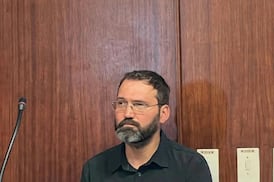
Lead author Viktor Radermacher, a former master’s student at the Wits Evolutionary Studies Institute in Johannesburg, said the discovery had left him feeling like a kid again.
“I feel like Peter Pan with this amazing discovery,” he said.
Radermacher said the discovery was vital in terms of being able to join dozens of research dots throughout the palaeontological world.
“This represents a turning point in understanding how dinosaurs evolved. This will help for future discoveries.”
The international Wits university-led team of scientists used a particle accelerator at the ESRF which emits high-powered X-rays to show, for the first time, how Tucky and his relatives breathed.

Radermacher said the work was important because it suggested the Mesozoic Era, known as the Dinosaur Times, had a landscape of animals breathing in different ways.
“Most animals do not breathe like each other, which not many people know. Mammals, like us, use a diaphragm, but the rest of the animal kingdom uses other means to cycle air through their lungs.
“We can tell how theropods and sauropods breathed from features left behind in their skeletons, some of which correlate to similar structures in birds. But that same evidence is not present in their herbivorous cousins.”
He said it had been a mystery to scientists because herbivorous dinosaurs had a different anatomy to other dinosaurs.
Radermacher said because of the dense iron within Tucky’s fossil, using normal X-ray machines proved overwhelming. The team took the specimen to the ESRF, which produces some of the world’s most powerful X-rays.
“In Tucky’s case it pays to be dead and interesting because he ended up getting a paid vacation to France.”

Using complex algorithms and specialised scans, which penetrated through the dense layers of iron, the team virtually reconstructed Tucky’s skeleton and was able to reveal anatomy hidden in the rock that showed how he breathed.
“The particle accelerator can detect subtle differences in structures. It allowed for Tucky, who is also the first dinosaur to be completely imaged from head to butt at the ESRF, to be completely visualised and for us to peer into the skeleton and unravel new and unexpected secrets.”
He said the scans showed that dinosaurs such as Tucky used oddly shaped ribs connected to their sternums to breathe, and that they also had a muscle attached to their hips which would inflate the lung, similar to how crocodiles breathe.
Radermacher said SA’s investment in the ESRF had been a boon for the country’s scientific output and global standing.
“The ESRF really allows us to maximise South Africa’s incredible fossil heritage.”
He said the findings were the foundation for future discoveries and breakthroughs.
“At the start of the End-Triassic extinction 200 million years ago, dinosaurs were preyed on by their then-larger crocodilians cousins.
“After the End-Triassic extinction the tables were turned and the crocodilians became secondary to dinosaurs. Maybe it is breathing that had something to do with dinosaurs taking over.
“Thanks to the ESRF and Tucky, who is a Proudly SA dinosaur, we have been able to produce research that is of global interest.”





Would you like to comment on this article?
Sign up (it's quick and free) or sign in now.
Please read our Comment Policy before commenting.