

I confess that I have been remiss in my duties to this column. There is a wonderful tale that I have not shared with you. I am now making amends.
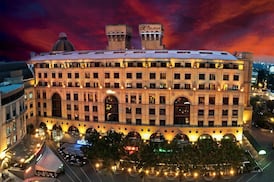
While I was taking the interview from the ostensible subject of this weekly gustatory fest, I realised I needed to double date as it were and record the inspiring story Paul Siguqa shared while he introduced us to his fine wines and libations at a recent Wine & Executive Club dinner at Fairlawns.
He had just poured us a glass of Nomaroma, the flagship Cap Classique from Klein Goederust, his 10ha wine farm in Franschhoek, and the room was held in the kind of suspended silence you usually get in a much more reverential setting.
His story begins with his mother.
“Where I grew up, if you were born to farm labourers, it was expected that you were going to be a farm labourer, and that your children would become farm labourers, and their children would become farm labourers. My mother believed that narrative was not correct. Why is it that the destiny of the children of farm labourers is already predetermined? She believed freedom would come, and when that day came, those who had an education would have a seat at the table.
“My mother didn’t have a formal education, but she believed education was the one thing she could give her children. So come Christmas, I got books. It’s your birthday; you get a book. You did well at school; you get a book. She used to say that her sole purpose in this life was to get us away from the farm.”
Siguqa pauses. “The irony is, here we are.”
My relationship with wine was broadened by the complexity of winemaking ... Suddenly markets were opening for South Africa and we were competing internationally. From that moment I knew that one day I would like to own a farm
— Paul Siguqa
Here is Klein Goederust, the Franschhoek farm Siguqa bought in 2019 after saving for 15 years, making it the valley’s first 100% black-owned wine farm.
His relationship with wine began in the farm labourers’ cottages his mother wanted him to escape.
“Growing up in the cottages of farm labourers, we had what was called the ‘dop system’. Farm labourers were paid very low wages, and part of the remuneration was wine. It wasn’t the kind of stuff you are tasting here today. It was the stuff that wasn’t going to make it to market. Imagine you have 50 families and you give every family five litres of wine on a Friday. You have chaos. You have abuse and, worst of all, foetal alcohol syndrome.”
Wine began to look different when, at 16, Siguqa worked at Backsberg Wines to help fund his education.
“I started in the cellar and later became a wine ambassador. My relationship with wine was broadened by the complexity of winemaking. There were talks about terroir, about soil and climate. There were cultivars. Suddenly markets were opening for South Africa and we were competing internationally.
“From that moment I knew that one day I would like to own a farm.”
So he saved.
“Some of the people closest to me said, ‘Why don’t you just buy taxis? Open a supermarket? Why this wine thing when there is nobody else doing it?’

“The rejection from banks was outright. They said it wouldn’t work. Development agencies said it wouldn’t work. The government said it wouldn’t work. We got rejected left, right and centre.”
Siguqa bought a dilapidated farm, removed the vines and started again.
“We were very clear that we were going to make small batches of high-end wines. Good wine is made on the land and not in the cellar.”
His winemaker, Rodney Zimba, grew up alongside him at Backsberg. Their parents worked together. And that brings us back to the glass in my hand.
“The bubbles you tasted are called Nomaroma. That’s my mother’s name. It is our flagship. My mother worked for 37 years making these exact bubbles. She knew everything about bubbles. She even knew when and how the pruning should happen in the chardonnay and pinot noir blocks. But she never got recognition for it.”
It was this terribly sad legacy he wanted to overturn. “The accolades never go to the person pruning in winter in the Western Cape on those beautiful farms. Nobody talks about the farm labourer harvesting in the heat of December, January and February.”
The rewriting of history at Klein Goederust extends beyond wine. When Siguqa bought the farm, elderly farm workers were still living there.
“Part of the deal was that everybody who was there would be given a house with their own title deed. My happiest day was seeing everybody walk away with title deeds to their own homes.
The narrative we hope to achieve with Klein Goederust is to say that it is possible ... Where you are born, who you are born to, or the colour of your skin shouldn’t predetermine where you end
— Paul Siguqa
“My experience of farms had not been very positive, and we cannot perpetuate that history.”
Ownership remains at the heart of his philosophy.
“The biggest barriers for black people in wine are access to land and access to capital. How do you make a wine farm profitable? Manage your costs, but most importantly, own the means of production.
“You need to own the land. You need to own every vine that you plant. After harvesting, you need to process your own product. Then the last part is access to market. You need to sell it.”
Today Klein Goederust has around 30,000 vines and its own production facilities. Yet for Siguqa the significance of the farm stretches far beyond what comes out of a bottle.
“The narrative we hope to achieve with Klein Goederust is to say that it is possible.
“If the child of a farm labourer can become a farm owner, then the child of the janitor, the child of the gardener, the child of the domestic worker, that child must become an astronaut.
“Where you are born, who you are born to, or the colour of your skin shouldn’t predetermine where you end.”







Would you like to comment on this article?
Sign up (it's quick and free) or sign in now.
Please read our Comment Policy before commenting.