

The shareholder war involving some of South Africa’s most luxurious hotels and lodges is heading to the Constitutional Court, where a Libyan-backed company will challenge a Supreme Court of Appeal (SCA) ruling that despite its interests having been unfairly disregarded, it must sell its stake and exit the business.
Ensemble Hotel Holdings, owned through a chain of Libyan investment entities, has approached the apex court seeking to overturn an SCA ruling compelling it to sell its stake in Legacy Hotels & Resorts.
Legacy is led and controlled by veteran hotelier Bart Dorrestein. The group also owns other luxury hotels, including:
- the Leonardo and DAVINCI hotels in Sandton;
- the Commodore Hotel at the V&A Waterfront in Cape Town; and
- several luxury bush lodges, including Kwa Maritane.
Ensemble estimates that its 39.79% share in Legacy is worth about R600m, while entities associated with Dorrestein own 60% of the company. The Michelangelo Hotel is wholly owned by Ensemble, but Legacy runs it through a management agreement.
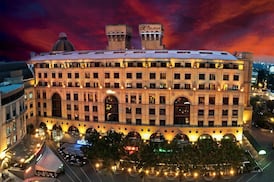
The low-rise five-star hotel — in Maude Street, adjoining Nelson Mandela Square — has been closed since 2020 due to the standoff between the two parties. It sits alongside the soaring 34-storey Michelangelo Towers, also owned by Legacy, which is operational. Ensemble has launched a separate process to hand over the management of the hotel to a different operator.
We are not seeking to perpetuate the deadlock or avoid a lawful separation
— Ziad Jamal Ali El-Barag, Ensemble CEO
Instead of having to sell its shares to Legacy, Ensemble wants the Constitutional Court to order that Legacy be auctioned off between the two parties. If this fails, Ensemble wants the matter sent back to a differently constituted panel of the SCA to come up with a just and equitable remedy.
“We are not seeking to perpetuate the deadlock or avoid a lawful separation. We are asking for a remedy that respects the right to a fair hearing, protects the value of the investment, and can lawfully be implemented,” said Ensemble’s CEO, Ziad Jamal Ali El-Barag.
According to court papers, the relationship between Ensemble and Legacy deteriorated over the years owing to tensions and disagreements over corporate governance, control and transparency. Things came to a head in 2021, when Legacy’s majority shareholders sought to transfer lucrative hotel management contracts from Legacy Hotels to a company called Legacy Hospitality. They argued that the sanctions imposed on entities in Ensemble’s Libyan ownership chain by the UN Security Council in 2011 created reputational issues and affected Legacy’s business negatively.
In court papers, El-Barag says Dorrestein and other majority shareholders engineered the move to shift management contracts to Legacy Hospitality as a strategy to muscle Ensemble out of Legacy. He also complained that, since he was not a director of Legacy Hospitality, he had no sight of the company’s business dealings, contracts and financials.
He told judges that the main shareholders shut him out of the company by repeatedly and over many months refusing to give him financial records and other critical information to help him fulfil his fiduciary duties.
By 2022, El-Barag’s relationship with Dorrestein was so strained that he went to the high court to demand, among other claims, Legacy’s financial records and that judges force a corporate divorce between Ensemble and Dorrestein through a private auction of shares for control of Legacy.

Dorrestein and his faction filed a counterclaim, arguing that Ensemble’s Libyan links prejudiced Legacy and amounted to oppressive conduct that impeded the company from doing business. As a remedy, they demanded that:
- Ensemble sell its stake in Legacy back to Dorrestein;
- Legacy buy back Ensemble’s shares;
- The value of Ensemble’s stake be determined by an independent expert;
- The value of Ensemble’s shares be backdated to January 29 2021;
- The expert be empowered to apply applicable and necessary discounts; and
- El-Barag resign from Legacy.
The high court granted Ensemble substantial relief, with judge Leicester Adams ordering Legacy to provide El-Barag with access to financial records and other information he had been denied. Adams confirmed that the repeated withholding of or delay in providing information constituted conduct that unfairly disregarded Ensemble’s interests.
Though Ensemble had argued that sanctions barred the sale of its shares and had proposed the sale of Legacy’s business instead, Adams found that the shares could lawfully be traded. He ruled that, since the relationship between Ensemble and Legacy had irretrievably broken down, a private auction in which the warring shareholder groups could bid for each other’s shares in Legacy was the best option. Adams also dismissed Dorrestein and his faction’s counterclaim, finding that Ensemble had not oppressed Legacy.
Dorrestein’s faction appealed, advancing what Ensemble described as contradictory submissions: it simultaneously asked the SCA to overturn the high court ruling that allowed the warring parties to bid for Legacy’s shares, contending Ensemble’s shares were frozen assets, and also requested that Ensemble be required to sell its shares to Legacy.
The SCA upheld the high court’s conclusion that Ensemble had been wronged and that Legacy’s decision to withhold financial records and other critical information from El-Barag violated his rights and unfairly prejudiced him.
The SCA also dismissed the Dorrestein faction’s counterclaim in its entirety, rejecting Legacy’s argument that Ensemble’s Libyan ownership structure amounted to oppressive conduct.
The SCA judges held that, while the effects of Libya’s sanctions meant that in the normal course of business Ensemble’s shares couldn’t be traded, they concluded that, provided the parties obtained the finance minister’s approval for the sale, under the country’s sanctions laws Legacy could proceed with Ensemble’s buyout.
The judgment gives no reason why Ensemble, rather than the majority, must be the party forced out
— El-Barag.
Despite the judges finding that Ensemble was the party entitled to protection and not the majority shareholders, they nevertheless granted the Dorrestein faction remedies that substantially resemble what was contended for in Legacy’s dismissed counterclaim.
In his affidavit to the CC, El-Barag complains that the remedies awarded by the SCA favour Legacy over Ensemble, instead of correcting the wrongs committed by Legacy, as identified by both the high court and the SCA.
He questions why Ensemble is being pushed out and he is being forced to resign despite findings that the majority shareholder’s counterclaim failed and the company had unfairly withheld critical financial records from him.
“The judgment gives no reason why Ensemble, rather than the majority, must be the party forced out,” said El-Barag.
He is also unhappy that, while three possible remedies were debated before the SCA, it ultimately imposed a compulsory buyout of Ensemble by Legacy without giving the parties a sufficient opportunity to challenge the specific terms and mechanics of the remedy that became binding on them.
El-Barag questions why the judges ordered that Ensemble be bought out by Legacy, subject to ministerial approval, before determining whether the finance minister actually has the legal power under the Financial Intelligence Centre Act to authorise such a transaction.
In his affidavit, El-Barag also stresses that Ensemble has been wrongly and unfairly painted as a sanctioned company, insisting that neither Ensemble nor its parent entity, Libyan African Investment Company, is on the UN sanctions list.
The dispute, he says, is not about a sanctioned company but rather about a specific Legacy shareholding that the courts have classified as a frozen asset because of its indirect links to Libya’s sovereign wealth structures.







Would you like to comment on this article?
Sign up (it's quick and free) or sign in now.
Please read our Comment Policy before commenting.