

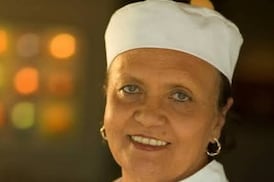
For Cass Abrahams’ children, some of their mother’s greatest culinary creations were not the elaborate dishes that earned her international acclaim, but the humble chicken pies that made everything feel right with the world.
“They were so comforting. You would forget everything else and feel like everything was going to be fine,” her daughter, Shakira Abrahams Buckley, said.
It is a memory that captures the woman behind the celebrated chef, cookbook author and champion of Cape Malay cuisine, who died at the age of 83 on Saturday after a long illness.
Buckley spoke to the Sunday Times two days after burying her mother, describing her as a “force of nature” who transformed a difficult childhood into a life dedicated to food, heritage and the stories carried through generations of family kitchens.
“She was quite an exceptional woman. She came from extremely difficult circumstances. Her father was killed when she was very young. She had a difficult childhood, and she rose through all that adversity and all the challenges in life and achieved so much,” Buckley said.
For decades, Abrahams worked to ensure that Cape Malay cuisine was not treated as a footnote in South Africa’s culinary history.
She began her career as a teacher at schools on the Cape Flats before becoming a home economist at Tastic Rice. But her passion for cooking took root after she married Buckley’s father and became part of a Cape Malay family.
She was particularly inspired by her husband’s grandmother, whom she regarded as an exceptional cook.
“My father’s grandmother did sort of teach her a bit,” Buckley said.
“But as far as the other old people go, she had to kind of steal with her eyes because Cape Malay people are very close with their recipes. They’ll tell you something, and they’ll leave something out.”
As Abrahams developed her own culinary voice, she became increasingly frustrated by what she saw as a food industry that celebrated European traditions while overlooking the rich culinary heritage of communities such as the Cape Malays.
“She used to tell a story about how, at the time, when they would ask chefs, ‘What’s your favourite food?’ they would say some kind of French something,” Buckley said.
“They didn’t acknowledge the fact that Cape Malay cuisine had recipes that were hundreds of years old, that were amazing and were unrepresented.”
For Abrahams, this was more than an omission from the culinary canon. It was the erasure of history.

She began researching the origins of Cape Malay cuisine, tracing recipes, traditions and the stories behind the food.
Buckley said her mother believed those stories had been overlooked because the food of ordinary families, particularly the food prepared by mothers and grandmothers, was rarely afforded the same prestige as that produced by celebrated chefs.
“She felt like the white male dominance of the food world was leaving out so much of the history because the stories of people’s cooking and their heritage all come from your mother’s table,” she said.
“These were not things that people were glorifying. They weren’t looking at your mother’s table. They were looking at the fancy chef in the kitchen.”
She felt like the white male dominance of the food world was leaving out so much of the history because the stories of people’s cooking and their heritage all come from your mother’s table
— Shakira Abrahams Buckley, Cass Abrahams' daughter
So Abrahams set out to change that.
Her cookbooks, teaching, research, and public appearances helped bring dishes such as bobotie, bredies, and denningvleis from Cape kitchens to audiences around the world.
But her greatest legacy may be the way she helped generations of people see their own food and the histories attached to it as worthy of celebration.
“It became her mission to represent the heritage, your mother’s food, the food that comforts, home and tradition and all of that,” Buckley said.
“That became sort of what she felt most passionate about.”
Now, as her family grieves, those grand achievements are intertwined with the small, intimate memories of the woman they knew at home: the mother whose food could comfort them when nothing else could.
For Cape Town, however, the loss is also that of a cultural custodian who spent decades making sure the stories simmering in Cape kitchens were heard far beyond them.
Cape Town mayor Geordin Hill-Lewis described Abrahams as a “beloved cultural elder” who gave generations of Capetonians a deeper appreciation of their heritage and the stories behind their food.
“Her legacy will live on in the kitchens, recipes and traditions of this city, and in everyone she inspired,” he said.
And perhaps nowhere will that legacy be felt more deeply than around the family table, where, long before she became a culinary icon, Abrahams was simply the mother whose chicken pies could make her children believe, for a moment, that everything was going to be fine.






Would you like to comment on this article?
Sign up (it's quick and free) or sign in now.
Please read our Comment Policy before commenting.