

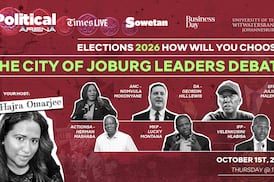
Ipsos research suggests that the ANC will emerge as the largest party at about 30% in the City of Johannesburg after the November 4 elections, paving the way for it to continue controlling the city together with the MK Party (11%), EFF (9%), ActionSA (5%) and PA (3%).
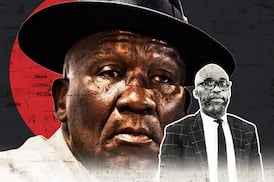
Prof Marius Pieterse reminds us that a city is judged by whether constitutional responsibilities translate into lived realities. Johannesburg enters the November elections needing precisely that test. If ANC coalition decision-makers must find common ground with Jacob Zuma, Julius Malema, Herman Mashaba and Gayton McKenzie, negotiations must be about Johannesburg, not positions or personalities. The coalition must become a government capable of rebuilding a city whose economic importance extends far beyond its boundaries.
Johannesburg is not simply another municipality. President Cyril Ramaphosa has described it as Africa’s financial capital, while city and Treasury data identify it as South Africa’s largest metropolitan economic contributor, generating almost 16% of national economic output and accounting for more than 1.8-million formal jobs.
The new administration should establish a 100-day stabilisation programme covering water, electricity, roads, waste, billing, infrastructure, municipal finance, public safety and economic recovery. But business must have a corresponding compact, requiring major companies to make substantial, transparent and measurable contributions to infrastructure, skills, youth employment, education, township enterprise, public spaces, digital systems, crime prevention and community development.
This is not charity or corporate takeover; it is recognition that the prosperity of Johannesburg and the prosperity of corporate South Africa are inseparable.
Crime must be a central pillar of reconstruction. Johannesburg needs co-operation between it, the police, Gauteng law enforcement, communities and business to confront gangs, drugs, illegal firearms, extortion, hijacked buildings, cable theft, cartels and organised criminal economies.
By 2031, residents should be able to judge whether Johannesburg is safer, functioning better, creating businesses and jobs, expanding economic opportunity and delivering services
— Grant Son
The private sector must contribute directly to metropolitan safety. Johannesburg possesses an enormous private security capability protecting corporate offices, shopping centres, residential developments, logistics networks and commercial assets.
That capacity should be integrated with municipal public safety structures and the SAPS through command centres, information sharing, camera networks, emergency response systems and hotspot intelligence.
Existing public-private initiatives demonstrate that such co-operation is possible. Business cannot secure its own buildings while surrounding communities remain unsafe.
Johannesburg should establish a data and evidence platform linking the government, universities, communities and business to analyse crime, unemployment, infrastructure, transport, gender-based violence and informal economic activity. A reconstruction fund could mobilise public, private and philanthropic capital under audited governance and measurable outcomes.
By 2031, residents should be able to judge whether Johannesburg is safer, functioning better, creating businesses and jobs, expanding economic opportunity and delivering services.
— Grant Son, e-mail
Alexa, write me an essay
The article “Principals wrestle with homework in the AI era” (Sunday Times, September 27) has to be a source of concern for educationists countrywide. It should generate discussion within our homes, school system and communities.
AI-assisted homework is an effortless copy-and-paste, misleading “learning” activity that will produce certificated robots that will not be able to function when their data is depleted or they are out of Wi-Fi range. The AI-dependent student-turned-worker will be unable to complete tasks, write and submit reports, jeopardising productivity and broad-based economic development as the primary goal of education.
AI-assisted homework must be closely controlled and monitored. With the advent of calculators, pupils were discouraged from dependency on them. On the right side of an examination page, we were supposed to show how we arrived at an answer. This also helped teachers see where we went wrong.
However, in our 4IR age, we cannot rule out AI homework assistance. It forms an integral part of the 21st-century economic revolution.
With such articles, I believe that we are charting a way out of our educational quagmire at a time when some matriculants get high marks, only to end up as higher education dropouts when challenged by undergraduate courses. AI, for all intents and purposes, is a shortcut to acquiring knowledge, but when badly used and depended upon, can also be a shortcut to schooling disaster.
— Moikwatlhai Seitisho, Phuthaditjhaba
New struggle, new allies
In response to Peter Bruce, Makhudu Sefara and Barney Mthombothi. The visa bans and the white cross protest in Washington highlight how poorly we understand how South Africa’s government is now perceived in the US — and how our arguments against every action and perceived slight reflect a fourth estate of limited ideological bandwidth.
Bruce tortuously attempts to draw equivalence between BEE and Ernst Roets’s white cross protest, and fails, mainly because there isn’t any. The Common Sense, in its own analysis, confirms that attacks on farmers are twice the national average and the likelihood of attacks ending in murder is seven times. And not all the murdered farmers named are white. Case closed.
Sefara wants Afrikaners to join a #NotInMyName protest against US lies. The absurdity of his jumbled logic appears to escape him. The ANC has implemented laws that discriminate against whites, this is a fact. That apologists want to call it constitutional redress does not change its reality. Turkeys don’t vote for Christmas.
Mthombothi then gets into the gutter with his “to hell” with the “five asks”, which should be thrown into the Potomac, in his view. Thoughtful and refined geopolitical analysis this is not.
But here’s the thing. Just as the ANC went capital to capital during the struggle, trying to find sympathetic audiences, so too are minority groups doing so now. Back then it was Moscow that opened the door, and today it is Washington. These people are not stupid, neither the Americans nor the Afrikaners. Understanding what is actually driving this and appreciating that addressing these issues is far from an assault on sovereignty would be helpful.
— Martin Neethling, Cape Town
Help boys learn nobility
Zingiswa Losi, president of Cosatu, told the world that South Africa is a violent nation. She gave examples of crimes committed. She said the problem in the country is not race-based crime. Most recently, the bodies of 12 women have been found in the Ekurhuleni area.
There is outrage at these horrific acts of crime, a justified reaction. These crimes are classified as GBV. It is generally accepted that men are responsible for GBV . The criminals responsible for these crimes must be punished. Outrage should also focus on addressing the root causes of these crimes. If these crimes are gender-based, then the boy child is central to eradicating these crimes, because he is the man of tomorrow.
Is society not neglecting the boy child at its own peril? What programmes are there for the boy child that prepare him for responsible manhood? What programmes does the government have for the boy child? Condemnation alone cannot be the solution. Why are we a violent nation?
— Lulamile Kilani , Durban
You can say that again
“Listen with your heart to the needs of the hard of hearing” (Sunday Times, September 27), by Benedict Maaga, resonated with me to a remarkable degree. Maaga detailed his own experiences as a hearing-impaired person operating in a world designed for people with full hearing.
Unlike many physical disabilities, deafness is not as apparent to the casual observer. Thank you for raising awareness, in such an interesting way, about the problems experienced by deaf people.
— Ian Warden (hearing impaired senior citizen), Rosebank






Would you like to comment on this article?
Sign up (it's quick and free) or sign in now.
Please read our Comment Policy before commenting.