
Story audio is generated using AI
Eugene de Kock, who was convicted of apartheid-era killings, has blamed the National Prosecuting Authority (NPA) for failing to seek information from him about killings and bombings allegedly ordered by police generals and politicians, including former president PW Botha.
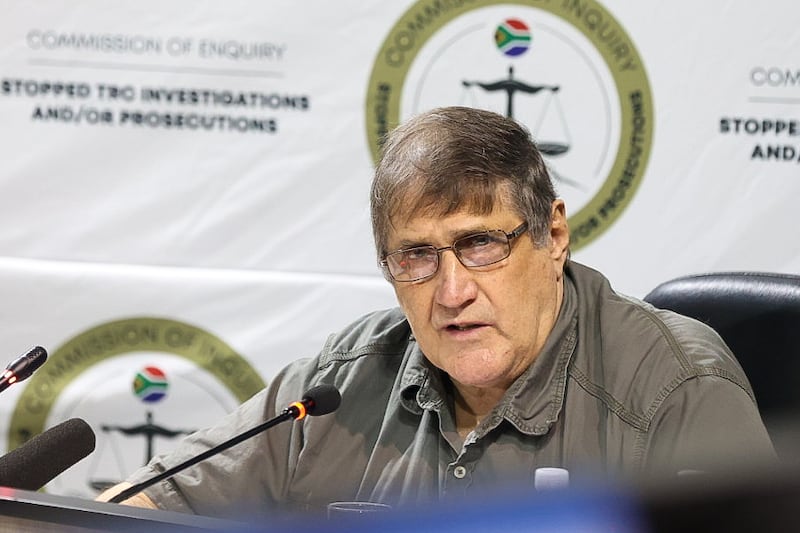
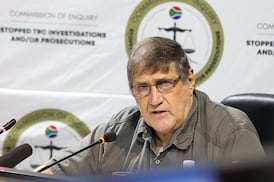
De Kock, who commanded the apartheid police death squad at Vlakplaas responsible for extrajudicial killings, testified on Monday before the Khampepe commission of inquiry, which is investigating allegations of political interference in efforts to investigate and prosecute crimes referred by the Truth and Reconciliation Commission (TRC).
De Kock’s evidence is crucial to the commission because he was convicted in 1996 of six murders, as well as conspiracy to murder, attempted murder, assault, kidnapping and other offences. The crimes related to the activities of what was known as “apartheid death squads”, which operated out of Vlakplaas near Pretoria and were responsible for several killings of political activists. The unit worked with uMkhonto weSizwe agents who turned and worked for the apartheid police. The agents were called “askaris”.
De Kock described himself as the middleman between high-ranking apartheid generals and officers who carried out killings and bombings, adding that his evidence would have been key to the NPA in seeking to prosecute, but “I was never asked”, even though he was “available all the time in prison”.
RECORDED | Eugene de Kock testifies at TRC inquiry
De Kock blames Anton Ackermann, who was the head of the NPA unit investigating TRC cases, saying that despite being called to meetings by Ackermann, he was never asked about TRC cases, those behind murders or politicians who issued instructions.
“It would therefore have been obvious to the prosecuting authorities that I would have a great deal of information that would be of relevance to the prosecution of other individuals as well as the generals who were in command and the politicians who instructed them.
“However, very little attempt was made by advocate Anton Ackermann or attorney-general advocate Jan d’Oliveira to interview me regarding my knowledge of apartheid-era crimes,” De Kock said.
Among politicians involved in apartheid crimes, he listed former presidents Botha and FW de Klerk.
“The politicians were definitely PW Botha, Adriaan Vlok and Louis le Grange, and at a later stage I did receive information that De Klerk, President de Klerk, the one that … urinated himself out of fear, gave the order for the killing of five children in Mthatha. I want to know why he was not prosecuted. He actually got a Nobel prize for killing children. I think it is disgusting. It should be recalled,” De Kock said.
The NPA has opened an inquest into the October 1993 killing of five youths, including two 12-year-olds, who were shot dead in a South African Defence Force raid on an alleged Azanian People’s Liberation Army (Apla) base at the Mpendulo residence in the Mthatha suburb of Northcrest.
Read: I did not direct the suppression of TRC prosecutions, says Mbeki
De Kock said that after the bombings were carried out by his unit, he was applauded by top politicians. But when the whip was cracked on apartheid crimes, he was the only one to be prosecuted and to serve jail time, and not those who issued instructions.
One of the police generals who was responsible for a killing pinned the crime on him.
“I have never been reluctant to provide information to the prosecuting authorities; however, they have simply never approached me to provide this information. I disclosed openly and fully my involvement in the crimes for which I had been charged. This would have provided the prosecuting authorities with ample evidence with which to pursue further prosecutions,” De Kock said.
De Kock said Ackermann said he knew that he had information about the apartheid human rights violation crimes, despite his not having disclosed such information to him. “I made it clear on many occasions that I wanted to testify; why was he [Ackermann] not prosecuting?”
Ackermann is due to return to the commission for cross-examination, and the allegations levelled by De Kock against him will be among the questions posed to him.
Ackermann previously testified before the commission on operational challenges which led to the failure to prosecute. He told the commission the Scorpions had declined to investigate TRC cases, leaving the NPA in a dilemma.
While allegations have been made that there were secret meetings between ANC officials and apartheid army and police generals to avoid prosecutions, De Kock said he was not aware of such meetings, but the commission should look at those who stood to benefit from the failure of prosecutions: the apartheid generals and politicians who issued instructions.
De Kock said he was willing to testify “even now” on apartheid killings and those who escaped prosecution.
“For the most part, my instructions came from very senior police officers: the generals. There was a chain of command, and I was a key link between the generals and those who carried out the operations.
“I was (and I am) able to provide evidence about (for example) the role played by Maj-Gen Izak ‘Krappies’ Engelbrecht, who was in the chain of command above me, and about a number of the other generals under whom I worked,” he said.
“The generals have not been prosecuted, despite judge Willem van der Merwe having found at the conclusion of my criminal trial that there was ‘more than enough evidence to charge Gen Engelbrecht’.”
He said his experience demonstrates that political office-bearers were both aware of and involved in what was happening.
“For example, to my personal knowledge, minister Louis le Grange signed off on the bombing of the ANC offices in London. He decorated the people who were involved in this, including me. Minister Adriaan Vlok visited Vlakplaas on many occasions. On one occasion he came there to congratulate me on the bombing of Khotso House [the offices of the South African Council of Churches] and Cosatu House.
“When I was instructed by Brig Willem Schoon to bomb Cosatu House, he told me that the instruction to do this was ‘from very high’. I asked him how high, and he said that it came directly from President PW Botha,” he said.
De Kock will return to the commission for cross-examination.
Business Day


Would you like to comment on this article?
Sign up (it's quick and free) or sign in now.
Please read our Comment Policy before commenting.