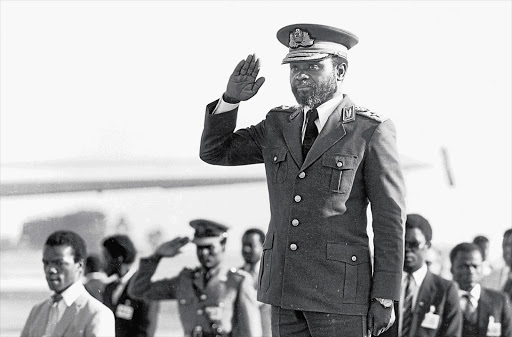
Top-secret inquiry into Machel crash
A TOP-SECRET inquiry has been launched into the plane crash that killed Mozambican president Samora Machel more than two decades ago.
The investigation by the Hawks began in earnest last month after a tip-off in January implicated apartheid-era government officials and security agencies, including the SA Defence Force, in engineering the crash.
A two-week investigation by The Times has revealed that an inquiry involving South African and Mozambican police, the National Prosecuting Authority and the Civil Aviation Authority started in November.
President Jacob Zuma is said to have sanctioned the inquiry, which is separate to that launched by the Justice Department.
Presidential spokesman Zanele Mngadi, whose office confirmed that the investigation had begun, referred questions to the Hawks.
Zuma's approval is believed to have been obtained on the strength of evidence obtained in September that includes documents, photographs and voice recordings.
The 15-member investigation team of South African and Mozambican police came into possession of the evidence as a result of the January tip-off.
The Times has learned that last week police crime scene experts took aerial photographs and GPS (global positioning satellite) readings in a restricted military zone at Mariepskop, Mpumalanga.
Radar installations in the zone feed aerial intelligence data from across Southern Africa to South African Air Force bases .
Mariepskop, near God's Window, is close to Mbuzini, where Machel's plane crashed, killing him and 24 others. Nine people survived.
The Times' source said: "Numerous reports from the Margo Commission of Inquiry are being reviewed, along with photographs and transcripts of flight voice data, and air traffic control recordings."
In 1987, Judge Cecil Margo exonerated South Africa of involvement in the crash and cited pilot error as the cause.
Russian experts concluded that the crash was caused by the crew being misled by signals from a decoy navigation beacon that transmitted more strongly than the beacon at Maputo airport.
In 1994, the cause of Machel's death was the subject of a closed Truth and Reconciliation Commission inquiry, which said it had evidence that linked the crash to the SA Defence Force.
NPA spokesman Makhosini Nkosi yesterday referred all questions to the Hawks.
Hawks spokesman Captain Paul Ramaloko confirmed the investigation.
"We are working with our Mozambican counterparts."
Mozambique embassy police attache Zachery Cossa said the embassy was aware of the investigation.
Civil Aviation Authority spokesman Phindiwe Gwebu said the authority was involved in the investigation.
An aviation source said: "The possible roles of certain people have been identified. Those alive cannot be allowed to escape justice like those who have died."
Dumisa Ntsebeza, the advocate who led the TRC investigation, said he had been approached by the Hawks.
"I was asked to reactivate my team. I told them if they had the budget we could. I have heard nothing from them since."
Ntsebeza said the investigation should have been done 14 years ago "when we told the Justice Department what needed to be done".
"We handed over 43 files of documents pertaining to murders, which we were unable to fully investigate because of time constraints. Among those files was this case," he said.
" Those documents contain detailed information, including a sworn statement by a military intelligence agent involved in setting up the false beacon.
"This agent gave detailed accounts of a meeting held the day before the crash, where this was planned. He gave names of those at the meeting, held at the former security police base Skwamans, close to the crash site. The next day these people were the first on the scene.
"Among those there were ministers and top military brass, including Pik Botha, defence force chief General Kat Liebenberg (who died from cancer in the 1990s), and military intelligence chief General Joffel van der Westhuizen."
Ntsebeza said: "What we discovered justified further investigations, including that the South African government was not 'uninvolved'.
"People die, memories fade, documents [get] lost and time [is] gained to cover tracks. If Samora Machel was lured to his death on South African soil it is a crime and a proper criminal investigation should have been conducted."
Ntsebeza said the Justice Department had a duty to prosecute those linked to the crime.
He said Machel's wife, Graca, told the TRC of a crisis meeting in Malawi, in February 1984, convened after Machel threatened to close Malawi's sea access if it did not stop helping Renamo.
"The possibility of assassinating Machel was allegedly discussed at this meeting. The following week, Malawi's president sent officials to meet President PW Botha, who sent a message of solidarity to Malawi through a delegation headed by Magnus Malan [the South African defence minister].
"It was Graca Machel's belief that the meeting discussed the formation of a special team to monitor Machel's movements. [Machel] was under enormous pressure at the time of his death, even from his own party. Graca Machel, a member of Machel's cabinet, confirmed [that there had been] attempts on his life at his residence, and South Africa's attempts to attack Maputo.
"Machel, at the time of his death, was engaged in a radical restructuring of his government and military, which could have upset a number of high-ranking Mozambicans."
Defence analyst Helmoed Heitman questioned the launching of the investigation.
"If the South African government wanted to kill Machel, there were simpler ways of doing it. I was privy to a briefing by a team of air force investigators ... certain allegations that the pilots were drunk were incorrect ... the crash's cause pointed to human errors, miscommunication and crew arrogance in terms of ignoring numerous warnings.''
Former foreign minister Pik Botha yesterday welcomed the new investigation.
"But only as long as it, like the Margo Commission, includes international air crash investigation experts. People forget that the [Margo investigation] also consisted of experts from the UK and US."
Responding to suspicions raised at the truth commission about his quick arrival at the crash scene, Botha said: "The commission came to the finding that South Africa was not involved - not me and not the government. As to my quick presence on the scene, this is [in accordance] with international protocol. I was never questioned over it then. I don't mind being questioned now," he said.
He questioned whether the truth commission had the expertise to reach its findings.


SHARE YOUR OPINION
If you have an opinion you would like to share on this article, please send us an e-mail to the Times LIVE iLIVE team. In the mean time, click here to view the Times LIVE iLIVE section.Tjorts
Posted 161 days agoAll this happened during the 'Cold War' ...and the most natural consequence of war are
CASUALTIES, i.e. Samora Machel & party. Samora Machel was a Communist, i.e. the enemy of the West at the time and a natural target to eliminate. To those who do not understand the primary objective of war:
...it is to eliminate the enemy! To single out or distinguish between certain 'battles' and call some 'murders' is simply ridiculous. As a leader of a neighboring country, Samora, him embracing Communism, was a threat to the safety and security of South Africa at the time ...this exposed him as a 'justified' target to intelligence authorities.
His choice after all and war have no winners...
The war on poverty should receive all the attention right now ...and the casualties should be the elimination of corrupt government officials and tenderpreneurs.
Let's get on with it...
v_3
(1) Loves a good conspiracy (the latest: Iranian spies are after Zwelinzima Vavi). I suppose when you have been in an "underground" movement all your life, paranoia is compulsory.
(2) The New-ANC is desperate for distractions from their misrule.
(3) Uniting around the horror of this crime suits them.
Spitfire
Posted 161 days agoswaziland2012
I understand that there are procedures to follow before an aircraft can descend and land at Maputo. Once the VOR is intercepted:
1. With the runway in sight and while maintaining minimum safety altitude, the pilot flies overhead the VOR station.
2. He then initiates the circuit over the airport area (45° starboard and then 225° starboard)
3. He is now positioned to intercept the ILS at 1700 feet.
After the premature turn to the right, Machel’s pilots could not see the runway lights, let alone intercept the ILS. This is what the crew said 6 minutes 49 seconds after the turn to the right:
Captain: There is no Maputo. Electric power is off, chaps
Navigator: ILS switched off…
Captain: Everything switched off.
Co-pilot: And they do not have electrical power.
And 3 seconds before impact:
Navigator: No, no, there is nowhere to go, no NDBs, there’s nothing.
Captain: Neither NDBs nor ILS.
In other words, the crew did not have the conditions at their disposal to initiate a descent and landing. Yet, in disregard of aviation procedure, they descended without the runway lights in sight and while unable to intercept the ILS and ignoring the GPWS (Ground Proximity Warning System) alarm, telling them they were going to crash.
There is one simple explanation as to why the pilots descended below minimum safety altitude and ignored the GPWS. They had no fuel to divert the aircraft to the alternate airport, which was Beira. The crew had failed to adequately refuel the aircraft for the Mbala-Maputo leg of the flight and had to land that night in what they thought would be Maputo, cost what may.
The rules are quite clear: fuel to reach destination and in the event of not being able to land at destination to divert the aircraft to the alternate airport and to remain on holding pattern over the alternate airport for 30-45 minutes.
The decoy beacon theory is hogwash designed to exonerate a crew supplied by the USSR to Mozambique and who caused the death of its president due to poor performance.
When Graça Machel was quoted as having told the TRC that Frelimo generals had collaborated with RSA intelligence in plotting the ‘assassination’ of her husband, a Political Bureau member of the ruling Frelimo Party commented: ‘Graça Machel knows too well that this crew had always caused us problems’.
Most probably, the Political Bureau member had in mind a flight involving the same aircraft and the same crew who overshot the Mocímboa da Praia runway in northern Mozambique weeks before the Mbuzini crash – with Graça Machel on board.
muk2
Posted 161 days agoSpitfire
RSA.MommaCyndi
Posted 161 days agoswaziland2012
Posted 161 days agoJoão Cabrita
cabritajm@gmail.com
RobNiemeyer
1) The aircraft was travelling directly west when it crashed. If it was travelling any other direction or angle it would have crashed in a very different place. That would imply it had turned west almost directly over Maputo airport. Surely a sudden right turn in the vicinity of the airport by the autopilot should have alerted the pilot that something was wrong?
2)Was the pilot not in communication with Air Traffic Control (ATC) at Maputo airport once he crossed into Mozambique airspace? From 10-12 kms out the pilot should have had visual references of the city , airport and runway. ATC should have been monitoring the flight and eventually indicating runway designation, compass bearings, any radio frequency changes etc. They should have advised the pilot that the aircraft had been identified via its transponder on the approach radar system.
3) Was the Soviet SAM 8/14 missile battery at Maputo not monitoring the flight if ATC was out of action/asleep. If so why didnt it raise the alarm when the aircraft suddenly turned right and traveled away from the airport?
4)If at 6 minutes out, the pilot was not in contact with ATC and had no visual reference of the runway approach, why did he continue? Surely he should have increased his altitude and gone into a holding pattern to find out from ATC what was happening and what procedure to follow?
5)If as was alleged, the power was out in Maputo and/or airport why did the pilot continue? Surely the airport would have had emergency power in the event of a power failure? If everything was in darkness, why did the pilot simply continue as if everything was normal?
6)The crash site would have been in total, absolute darkness and his terrain warning alarm would have been screaming long and loud. Why did the pilot not take any emergency action to increase altitude and try to raise Maputo ATC?
My humble opinion is that the pilots failed miserably to carry out the correct procedures, ie it was simply pilot error on a grand scale. They caused the crash even if there was a so-called alleged false beacon. There were enough elements in the last 30 minutes of flight to indicate the situation was far from normal and that they should take corrective/avoidance action.
swaziland2012
1. Aerodrome Controller - responsible for aircraft movement in the aerodrome area, including take-off and landing;
2. Approach Controller - responsible for descent, approach and landing procedure; and
3. Area Controller responsible for every flight in the aerodrome's jurisdiction area.
Jesus Cardoso, the air traffic controller on duty on the night of the accident, was an Aerodrome Controller (Category 1). Under the Mozambique Government's Protocol on Presidential Flights, this was a VIP flight. Appropriate measures should have been put in place, notably assigning a senior air traffic controller for the return flight from Mbala.
Under the same Protocol, VIP flights such as this should have a ʺreinforced crewʺ (Tripulação Reforçada), that is, 2 Captains and 1 Co-pilot. The Tupolev crew on the 19 October 1986 flight from Maputo to Mbala and return had one Captain only – who was on duty for at least 14 hours, which is well above the standard 8-hour shift.
The Protocol states that Flight Plans should be filed through the Foreign Ministries of the countries concerned at least 24 hours in advance. The plan for the outbound flight was filed minutes before departure. No Flight Plan was filed for the return flight.