
Story audio is generated using AI
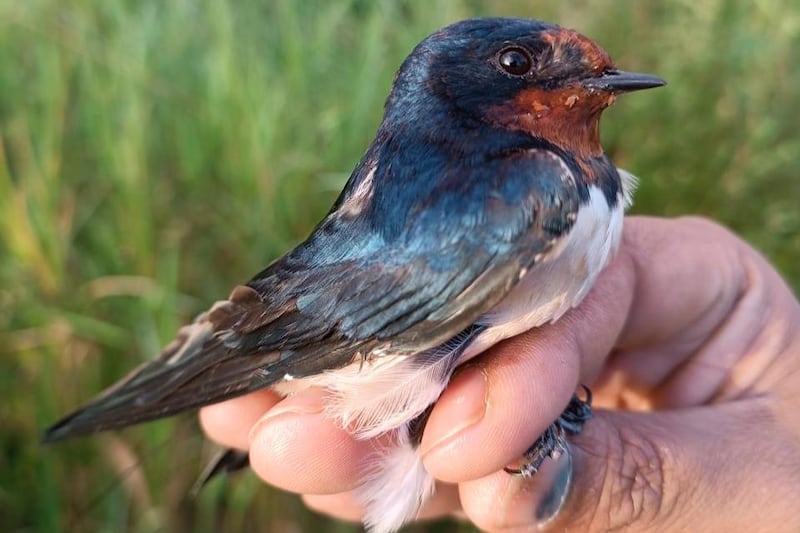
When about 3-million Barn Swallows come home to roost in KwaZulu-Natal from this month they can do so more safely now thanks to a pioneering bird radar programme.
Home is Mount Moreland near King Shaka International Airport (KSIA), the construction of which was met with concern from ornithologists and birders over the future of the feathered species which migrates from Eastern Europe to settle in the reed bed area at the Lake Victoria Conservancy from October to June.
In approving the R7.2bn airport and trade zone in 2006, the department of environmental affairs and tourism then set as one of the more than 80 conditions that “flight schedules must be planned around the flight times of the swallows” because of the risk of bird strikes.
At dawn and dusk the little birds form massive airborne flocks and pose potential danger as their flight paths intersect with aircraft operations around the airport.
Now a pioneering project between King Shaka International Airport and the University of KwaZulu-Natal will help scientists understand migratory movement of several bird species and over a larger flight path.
To address the bird strikes, KSIA has upgraded to a Robin Radar Systems MAX bird detection radar, a full 3D avian radar system capable of monitoring bird movements in real time.
The radar can track more than 3,000 birds simultaneously within a 15km radius, providing detailed information on flight paths, altitude, speed and flock behaviour.
Bird strikes are increasingly becoming a challenge to operational continuity. Recent data from the US Federal Aviation Administration recorded more than 22,000 wildlife strike incidents in 2024, a year-on-year increase that outpaced growth in aircraft movements.
— Nkosinathi Myataza, Airports Company South Africa regional general manager
Nkosinathi Myataza, Airports Company South Africa regional general manager, said: “Bird strikes are increasingly becoming a challenge to operational continuity. Recent data from the US Federal Aviation Administration recorded more than 22,000 wildlife strike incidents in 2024, a year-on-year increase that outpaced growth in aircraft movements.”
He said birds accounted for the overwhelming majority of these events.
“While most do not result in catastrophic outcomes, their operational consequences extend far beyond the safety incident itself.”
He said a single strike can trigger unscheduled maintenance, aircraft inspections, flight delays, diversions, and, in some cases, aircraft-on-ground events.
“These disruptions are often short in duration but high in cumulative cost, affecting airline reliability, network efficiency and passenger experience across tightly interconnected aviation systems.”
He said the technology provides wildlife management teams “unprecedented visibility of bird activity around the airport, enabling proactive decision-making that strengthens aviation safety while protecting local biodiversity”.
The new technology replaces the DeTect Merlin Bird Detection Radar system installed at KSIA about 15 years ago to monitor the Barn Swallows.

For UKZN researchers the technology offers far more than an aviation safety solution.
The university’s Discipline of Biological Sciences is an integral part of the programme through a dedicated research partnership aimed at advancing scientific understanding of bird movements around the airport, migration arrival and departure patterns and habitat use in the vicinity.
The research team is led by Prof Colleen Downs, National Research Foundation South African Research Chairs Initiative (SARChI) chair in ecosystem and biodiversity in KZN and the Eastern Cape.
Working alongside Downs are Dr Cameron Cormac, a Postdoctoral Fellow, and MSc candidate Matthew Wilkinson, who are actively contributing to the project by gathering field data, identifying bird species and correlating field observations with radar detections.
The team is also responsible for populating the radar system’s species database, enabling researchers and airport officials to better understand which bird species are being detected and how they move through the surrounding environment.
Cormac said the previous system only tracked Barn Swallows while this new technology has a much wider range and is able to track a wider variety of birds.
“The information will help us better understand changing migratory patterns for example we are seeing a trend of the Barn Swallows leaving slightly earlier.”
He said this is a pioneering study and would help understand the impact of linear infrastructure on birds and their flight patterns.
Traditional bird monitoring methods have relied heavily on human observations and occasional Global Positioning System (GPS) tracking studies. While these approaches provide valuable insights, they are often limited by daylight hours, weather conditions and the relatively small number of birds that can be monitored at any one time.
“The new radar technology offers a transformative opportunity for ecological research by continuously monitoring birds active in the vicinity of the airport simultaneously, day and night, throughout the year,” said Downs.







Would you like to comment on this article?
Sign up (it's quick and free) or sign in now.
Please read our Comment Policy before commenting.