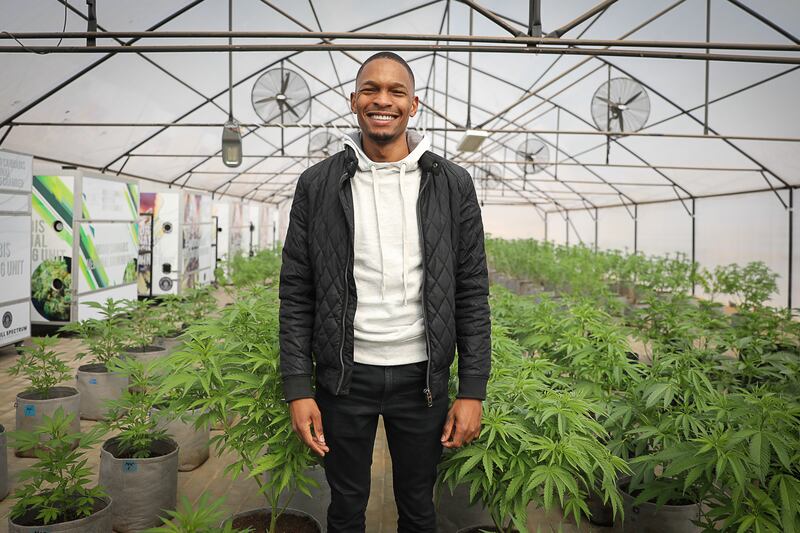
Kwanda Mtetwa, who suffered serious multiple injuries in a 2011 motorbike crash, was so desperate for an alternative and safe pain treatment that he grew marijuana when it was still illegal to do so.
Now the 32-year-old has become the first South African to receive a legal prescription for medical marijuana, a growing industry that some believe could bolster economies, help people suffering from chronic pain and create jobs.
“I was bedridden for eight months and relying on heavy pain medication. My mood shifted and my character changed ... I wasn’t eating and grew thin. The whole time the pain continued and I didn’t sleep for days.
“I was worried the meds would make me an addict. Two years down the line and they were burning my stomach. I started looking for an alternative pain relief.”

Mtetwa tried marijuana in 2014, but had adverse effects from heavy-metal crop sprays used by the illegal grower.
So he began illegally cultivating his own and was finally freed from pain and the medication that made him ill.
Today he’s a medical cannabis activist lecturing at Cheeba Cannabis Academy.
Mtetwa was introduced to Vaal grower CBD Full Spectrum last year and began taking marijuana legally as a patient. His prescription is for a hybrid strain known as Cheese.

He and other patients carry cannabis permit cards with a QR code authorities can scan to access the holder’s information and, as with other schedule 6 medication, the card is valid for six months.
Though the cannabis draft bill allows for the legal use and possession of marijuana, CBD Full Spectrum’s CEO Prof Benny de Beer said the danger was that the composition of products was often unknown.
For a crop to meet medical-grade standard it must be tested to ensure no pesticides or harmful products were used. Its THC levels (Tetrahydrocannabinol is the psychoactive compound that gives the high) also have to be tested so doctors can prescribe the right strain for patients.
In February, during his state of the province address, premier David Makhura said Gauteng would bolster its economy by becoming the industrial hub of cannabis.
“We already have the industrial infrastructure,” he said.
As a grower and cultivator, CBD Full Spectrum is the biggest in the industry, with five approved farms and another five awaiting approval. Its harvest is tested and categorised before being sold to international buyers and SA’s Releaf Pharmaceuticals, a company that meets SA Health Products Regulatory Authority (Sahpra) and Complementary and Alternative Medicines requirements.
Patients buy their medication from these approved pharmacists. The hope is that medical marijuana will eventually be sold in regular pharmacies.

Dr Benny Malakoane, who prescribed Mtetwa’s marijuana, said when justice Raymond Zondo handed down the pro-cannabis ruling in 2018, he “opened the floodgates”.
“Zondo gave people leeway to plant and to use without regulation on how it was to be used. Without monitoring and regulating we don’t know what we are taking. This is how black-market dagga differs from medical-grade marijuana.
“When a doctor prescribes for medical use, they do so as they would for any other medication - the dosage, the strain, frequency and time of day are all specified to treat the ailment.”
Malakoane specialises in pain relief and experienced the herb for the first time this year.
“We were to start giving it to patients, so I needed to be able to tell the patients what the experience would be. I took 0.05ml of activated cannabis oil and felt nothing for two hours. Then it hit. The next day I woke up feeling wonderful.”
He prescribes marijuana in 0.5g/ml doses from three strains known for their indica, which induces relaxation, and sativa, which tends to enhance energy levels.
He describes them as:
- Cheese - 40% indica, 60% sativa, with a 12% THC level “best taken in the morning as it gets you up and energised”.
- Charlotte’s Angel - About 50% indica, 50% sativa, with a 7% THC level “best taken around midday. It’s middle ground.”
- Blue gelato - 60% indica, 40% sativa, with a 20% THC level “best taken at night to relax you”.

De Beer estimated that within two to three years the industry could create a million jobs. The 2ha Vaal farm will eventually have 14 greenhouses, producing three tonnes a year. Before Covid-19 emerged, the farm had 44 employees. It now has 14, but expects to have more than 1,400 employees by next year, when it is able to export again.
When Sunday Times Daily visited on Thursday, Zolisile Sikota, 50, from Pondoland in the Eastern Cape, had driven 1,000km to the farm to register and get a prescription.
“I had a car accident in 2015 and broke my shoulder. Marijuana is the only thing that helps ease the pain.”
De Beer said Sikota’s long journey was proof people were eager to use the medication without taking advantage of their newfound freedoms.